FRC vs. FTC: Which Robotics Program Is Right for Your School?
FRC vs. FTC compared: 2026-27 costs, team size, robot size, time and space, plus what mentors say after running both, so your school can choose the right robotics program.
Your school wants a robotics team. You’ve heard of FIRST, and now you’re stuck on the first big choice: FRC or FTC?
Here’s the short answer. FTC (FIRST Tech Challenge) is cheaper, smaller and easier to start. FRC (FIRST Robotics Competition) is bigger, louder and more expensive, with room for as many students as you can recruit.
Most new schools are better off starting with FTC. But if you already have money, mentors and a place to build, FRC can be worth it. This guide walks through the real 2026-27 costs, what each program asks of your school, and what teachers and mentors say after running both.
What are FRC and FTC?
Both are run by FIRST, the nonprofit behind most school robotics programs in the U.S. Both release a new game each season, and teams design, build and program a robot to play it. The difference is scale.
FIRST Tech Challenge (FTC) is for grades 7 to 12. Teams of up to 15 students build a robot that starts inside an 18-inch cube. The game is released in September, and the 2026-27 game is called BIOBUZZ.
FIRST Robotics Competition (FRC) is for grades 9 to 12. Teams can be any size, and the robots are much bigger, usually capped at around 115 to 125 pounds depending on that year’s rules. The game is revealed at kickoff in January. For 2027, kickoff is January 9.
A common way to picture it: FTC robots are about one-third the scale of FRC robots, played on a 12-by-12-foot field instead of one about 27 by 54 feet.
FRC vs. FTC at a glance
| FTC | FRC | |
|---|---|---|
| Grades | 7 to 12 | 9 to 12 |
| Team size | Up to 15 students | No limit |
| Robot size | Starts inside an 18-inch cube | Up to about 115 to 125 lb |
| Game released | September | January |
| Season registration (2026-27) | $350 | $6,500 |
| Robot kit | About $1,500 to start, reusable | Kit of Parts included, but most teams spend thousands more |
| Events included | None; local events cost extra | One regional or two district events |
| Typical season budget | A few thousand dollars | About $24,000 to $26,000 |
| Space needed | A classroom and storage cabinet | A shop or large room, plus practice space |
| Best for | New teams, middle schools, small groups | Established programs with mentors and funding |
How much do FRC and FTC cost?
Cost is the biggest difference, and it’s not close.
FTC: Season registration is $350 for 2026-27. FIRST estimates about $1,500 for a starter robot kit, including a driver kit ($295), a REV Control Hub ($350) and a build kit ($660). Local event fees are set by your region, so check with your local FIRST partner (FIRST).
The kit is reusable. After year one, many FTC teams spend far less, mostly on new parts, events and travel.
FRC: Season registration is $6,500, due November 17, 2026. That includes the Kit of Parts plus one regional event, or two district events. Extra events cost $3,200 for a regional or $1,000 for a district event in most districts. The District Championship is $4,000, and the FIRST Championship is $6,000 (FIRST).
Once you add robot parts, tools, travel and spares, a typical U.S. FRC team spends about $24,000 to $26,000 a season. We break that down line by line in our guide to building a robotics team budget.
The quick math: one FRC season costs about the same as running several FTC teams for years.
Time, space and mentors
Money gets the attention, but these three decide whether a team survives past year two.
Season length. FTC runs from the September game release through winter, with qualifiers spread across fall and early spring. FRC is packed into a short, intense stretch: kickoff in January, then a few weeks of building before events start, often with long nights and weekends.
Space. An FTC robot fits on a desk, and the whole team can work out of a classroom with a storage cabinet. An FRC robot needs a shop, power tools and somewhere to drive it. Many FRC teams build a partial practice field.
Mentors. Both programs need adults, but FRC needs more of them. Beyond technical help, someone has to handle registration, travel, hotels, fundraising and the school paperwork. Mentors on Chief Delphi, the main FRC forum, often say this is the job new teams forget about (Chief Delphi).
Team size. FTC caps each team at 15 students, which keeps everyone hands-on. FRC has no cap, so a big school can fit everyone on one team, but some students end up watching instead of building.
What students learn in each
Both programs teach the same core skills: CAD, programming, building, testing and working on a team under a deadline. Both also judge teams on more than the robot, with awards for engineering documentation, outreach and team spirit.
The difference is depth versus breadth.
In FTC, each student touches more of the robot. With 15 people or fewer, the same student might design a part, wire it and help code it. That hands-on ownership is the reason many mentors prefer FTC for newer students.
In FRC, the work is closer to industry. Robots use bigger motors, metal fabrication and full electrical systems, and teams split into sub-teams like mechanical, electrical, programming and business. Students go deeper in one area.
For college and careers, both count. FIRST connects participants and alumni in both programs to scholarships and employers through its Classroom to Career program, and colleges recognize both on applications.
What teachers and mentors say after running both
We read through years of threads on Chief Delphi from mentors, teachers and students who have run FTC, FRC or both. A few themes came up again and again.
New FRC teams often don’t last. One mentor looked at the new FRC teams from their state that got team numbers in the 8000s. Ten of the eleven had already folded. The one that survived was an existing FTC team that moved up with several experienced FRC mentors (Chief Delphi).
FTC is easier to start and keep going. In a long thread about growing FIRST, one mentor argued that thousands of students would be better served by FTC, since it’s cheaper, easier to launch, less time-consuming and needs less space (Chief Delphi). Another said adding an extra FTC team costs only a few hundred dollars a season, as long as there’s no overnight travel (Chief Delphi).
Small teams mean more ownership. Several mentors pointed out that students on a small FTC team get far more say in the robot. One noted that when given the choice, many of their students preferred to stay in FTC rather than move up to FRC (Chief Delphi).
FRC needs a long-term adult. One veteran put it plainly: if you can’t find an adult who’s excited to run an FRC team for the next five years or more, FTC or VEX is the better choice (Chief Delphi).
But FTC isn’t just “FRC practice.” Some FRC mentors warn against treating FTC as a training league for the big robots. They see it as its own program, worth doing for its own sake (Chief Delphi).
Some schools do both. A common setup is FTC for middle school or newer students and FRC for experienced high schoolers. One teacher who has run VEX, FRC and FTC described FTC as the casual robotics club and FRC as the advanced one (Chief Delphi).
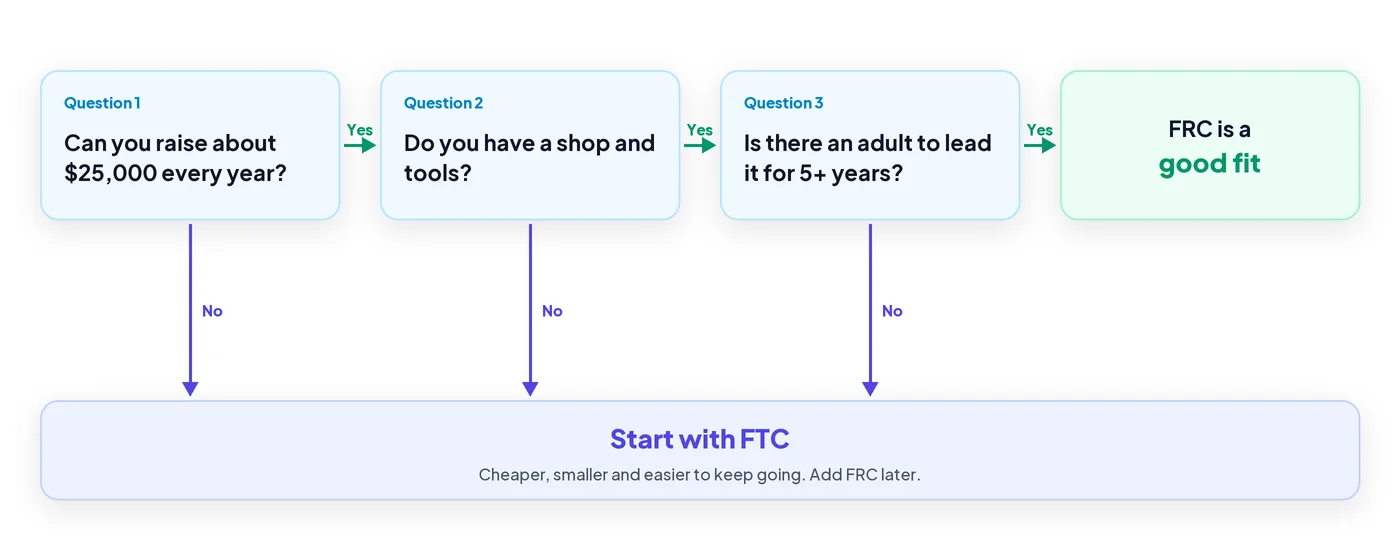
Which one is right for your school?
Answer these five questions honestly.
- Can you raise $25,000 every year? Not once. Every year. If not, start with FTC.
- Do you have a shop and tools? If you’re building in a classroom, FTC fits. FRC needs real shop space.
- Do you have an adult who will lead it for five years? FRC especially needs a committed lead mentor, plus parents for travel and logistics.
- How many students want in? Under 15, FTC is perfect. Far more than that, either run several FTC teams or consider FRC.
- Are there middle schoolers? Only FTC allows grades 7 and 8.
Choose FTC if you’re new to robotics, working with a smaller budget, building in a classroom, or including middle school students.
Choose FRC if you have steady funding, a shop, experienced mentors and a large group of high schoolers who want a bigger challenge.
Not sure? Start with FTC. Remember the one new FRC team that survived in that mentor’s state: it started as an FTC team. You can always add FRC later, once you have the people and money to support it.
How to plan your first season
Whichever program you pick, the first season goes better with a plan made before kickoff.
- Find a nearby team. Use FIRST’s team search to find veteran teams near you. Most are happy to share advice, spare parts and even shop time.
- Lock in your money and dates. For FRC, registration is due November 17, 2026, and extra event fees are due January 21, 2027. For FTC, register early so you can sign up for local qualifiers before they fill.
- Recruit adults early. You’ll need at least one technical mentor and one person to handle logistics.
- Start simple. Mentors repeat this constantly: don’t design a custom robot from scratch in year one. Use the kit, get it driving, then improve it.
- Plan the season backward from your first event. Work back from the event date to set when the robot must drive, when the design must be final, and when parts must be ordered.
Plan your robotics season in Flowboard
A robotics season has a lot of moving parts: deadlines, orders, design decisions and people. Flowboard puts the whole season on one board.
- Map the season step by step, from registration to your last event, with an owner on every step (visual project planning).
- Hold orders until the design is final with gates, so nobody buys parts for a mechanism you drop (gates).
- See every deadline on a timeline and calendar, next to build milestones (project timelines).
See how engineering teams use it on our page for engineers, or start a free trial and plan your first season.
Sources
- Cost & Registration, 2026-2027 season pricing, FIRST
- Classroom to Career & Scholarships, FIRST
- “Starting a frc team”, Chief Delphi
- “FRC Blog: Differentiating FIRST Programs”, Chief Delphi
- “Hey Dean, if you want more teams”, Chief Delphi
- “Rethinking our FTC team(s)”, Chief Delphi
- “Trying to start a new FRC team”, Chief Delphi
- “FTC and FRC question”, Chief Delphi
- “FTC New Team Questions”, Chief Delphi
Frequently asked questions
Is FTC easier than FRC?
FTC is easier to start and run, with smaller robots, smaller teams and much lower costs. The engineering is still real, though, and top FTC teams build very advanced robots.
How much does it cost to start an FTC team?
For 2026-27, registration is $350 and FIRST estimates about $1,500 for a starter robot kit. Add local event fees and some extra parts, and most new teams need a few thousand dollars in year one.
How much does it cost to start an FRC team?
Registration alone is $6,500 for 2026-27. With parts, tools, travel and spares, a typical U.S. team spends about $24,000 to $26,000 a season.
Can middle school students join FRC?
No. FRC is for grades 9 to 12. Middle schoolers in grades 7 and 8 can join FTC.
Can a school have both FTC and FRC teams?
Yes. Many schools run FTC for middle school or newer students and FRC for experienced high schoolers. Mentors suggest keeping each student on one team per season so the programs don’t compete for time.
How many students can be on an FTC team?
Up to 15. If more students want to join, many schools start a second FTC team.
Do colleges care which program you did?
Colleges recognize both. What stands out on an application is what you actually did: the parts you designed, the code you wrote, or the team you led.