How to Build a Robotics Team Budget (and a Bill of Materials)
How to build a robotics team budget and bill of materials, with FIRST’s 2026-27 fees, median FRC costs and a sample season plan you can copy.
Most robotics teams don’t run short because the robot cost too much. They run short because of things nobody wrote down in the fall: the extra event, the hotel, the spare motors, the Championship trip nobody expected to earn.
A robotics team budget feels like paperwork, so it gets handed to whoever says yes. Then build season starts, three people are ordering parts, and by March nobody can say what’s left.
By the end of this post, you’ll have:
- The real 2026-27 costs for FRC and FTC, straight from FIRST: registration, extra events, championships and the median team budget
- A 7-step method for building your team’s budget before kickoff
- A bill of materials setup that tracks every part and every dollar in one list
- A sample rookie budget you can copy and adjust to your team
- The mistakes that drain team accounts, drawn from what mentors share on Chief Delphi, the main FRC forum
It’s written for FRC teams, with notes for FTC.
How much does a robotics team cost?
A typical FIRST Robotics Competition (FRC) team in the U.S. spends about $24,000 to $26,000 a season. That’s the median FIRST reports from teams, updated in July 2026. Teams outside the U.S. run a little higher, mostly because of travel.
Here’s where the money goes for a median U.S. district team:
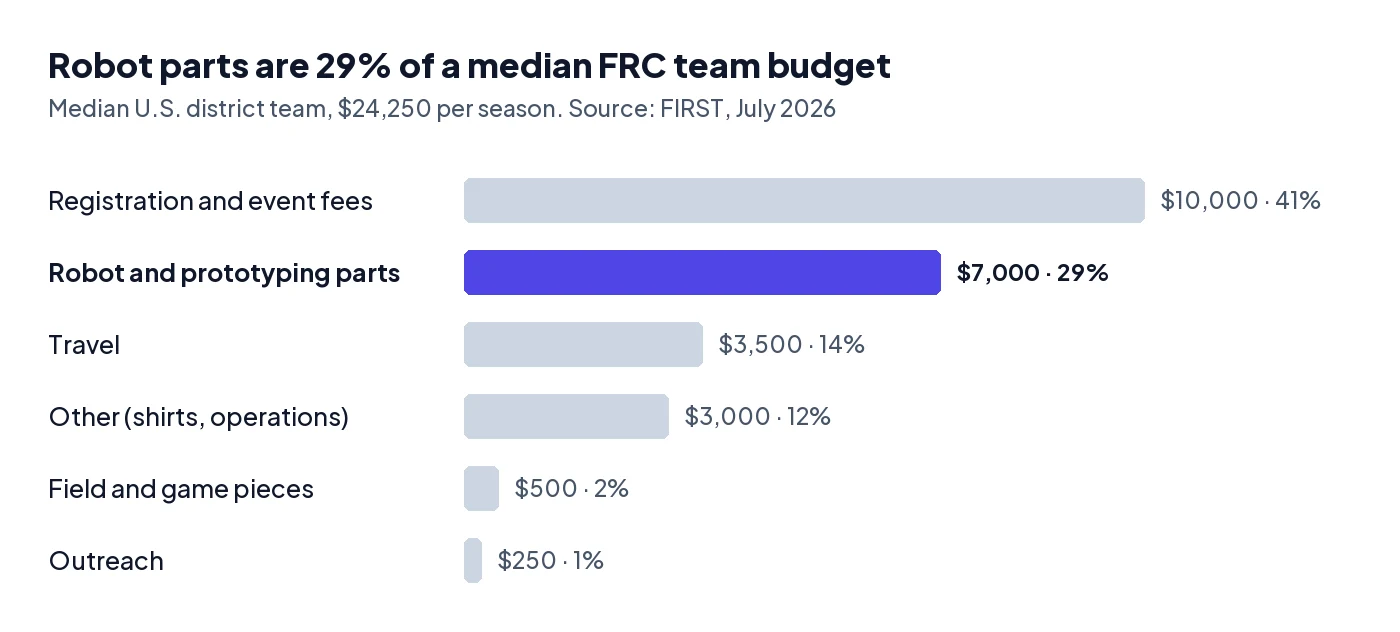
Regional teams look almost the same at $25,550 a season. They pay slightly less in fees ($9,300) but more for travel ($5,000) and robot parts ($7,500).
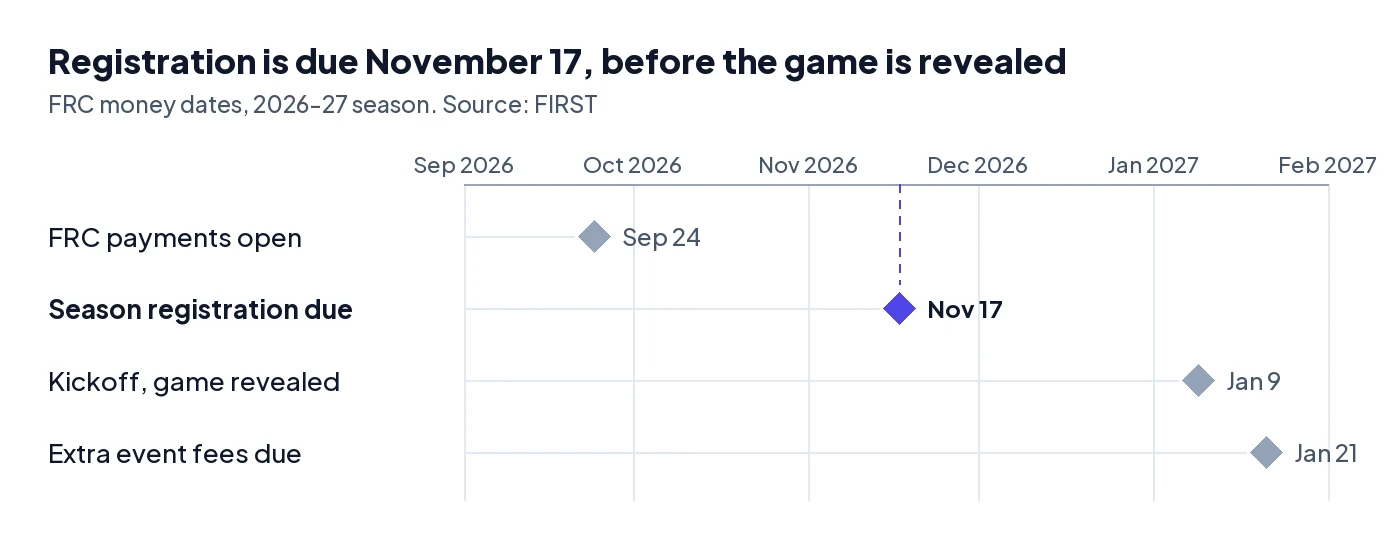
The biggest single line is registration. For the 2026-27 season, FRC registration is $6,500. That covers your Kit of Parts plus one regional event, or two district events. Extra events cost more: $3,200 for another regional, or $1,000 for another district event in most districts. Qualify for the District Championship and that’s $4,000. The FIRST Championship is another $6,000.
FIRST Tech Challenge (FTC) is much cheaper. Registration is $350, and FIRST estimates about $1,500 for a starter robot kit. Local event fees are set by your region, so check with your FIRST partner.
One thing to notice: the robot itself is less than a third of an FRC budget. Most new teams plan the robot first and find out about everything else later.
How to build a robotics team budget, step by step
Build the budget before kickoff, not during build season. Once the game is revealed, nobody has time to think about money.
- Start with what’s fixed. Registration comes first: $6,500 for FRC or $350 for FTC. For the 2026-27 season, FRC registration is due November 17, 2026, and fees for extra events are due January 21, 2027. Put both dates on your calendar now.
- List what your team already has. Before you price a single part, write down your mentors, machine shop access, tools and how many experienced students are coming back. One veteran mentor on Chief Delphi suggests doing this every off-season. It tells you what to build yourselves and what to buy.
- Price travel per event, not per season. Multiply people by nights by hotel cost, then add buses and meals. A district event an hour away and a regional across the state are very different numbers.
- Split robot money into buckets. Use drivetrain, mechanisms, electronics, prototyping and spares. If you’re new, ask a nearby veteran team what share they give each one. Mentors on the forum say most teams are glad to share.
- Add an “if we qualify” line. The FRC District Championship is $4,000 and the FIRST Championship is $6,000, before travel. You don’t have to raise it in advance. Decide now who you’d ask if it happens, because you may get only a few weeks.
- Be honest about income. Rookie teams usually can’t count on big sponsors in year one. Forum mentors keep pointing to two better leads: companies where students’ parents work, and local small businesses. Also check FIRST’s grant opportunities and any state robotics grants.
- Plan to finish with money left over. FIRST itself recommends ending the season with a surplus so next year doesn’t start at zero. Even a few hundred dollars covers early off-season parts.
How to build a robotics bill of materials
A bill of materials (BOM) is the list of every part on your robot, with where it came from and what it cost. It’s how the robot line of your budget stays honest.
The trick is to keep one list, not two. On Chief Delphi, one mentor who handles all of their team’s money described a single spreadsheet that logs every purchase and also produces the robot BOM. That one sheet answers both “what’s on the robot?” and “where did the money go?”
Here are the columns worth having:
| Column | Why it matters |
|---|---|
| Part name and vendor part number | So anyone can reorder it |
| Subsystem | Ties each part to a budget bucket |
| Quantity and unit cost | Gives you the running total |
| Link | Saves time when ordering |
| Requested by | Shows who to ask about it |
| Status | Requested, ordered, arrived or on the robot |
A few habits make the list work:
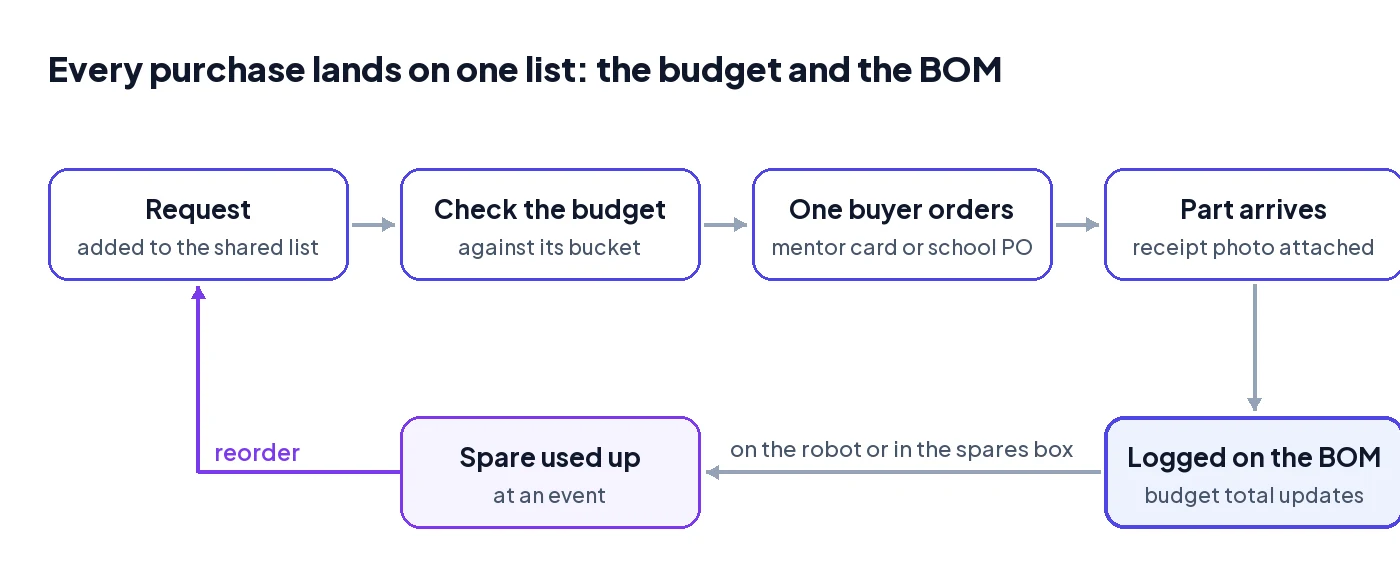
- Let one or two people place orders. Everyone else adds requests to the shared list. Teams on the forum say this is what stops double orders.
- Keep every receipt. Snap a photo and attach it to the line. You’ll need it for reimbursements and grant reports.
- Check how your school pays for things. Some school purchase orders take weeks to clear, which doesn’t work in build season. Many teams use a mentor’s card and get reimbursed. Agree on the process before January.
- Restock spares between events. Whatever you pulled from the spares box at your first event, reorder before the second.
Example: a rookie FRC team’s season budget
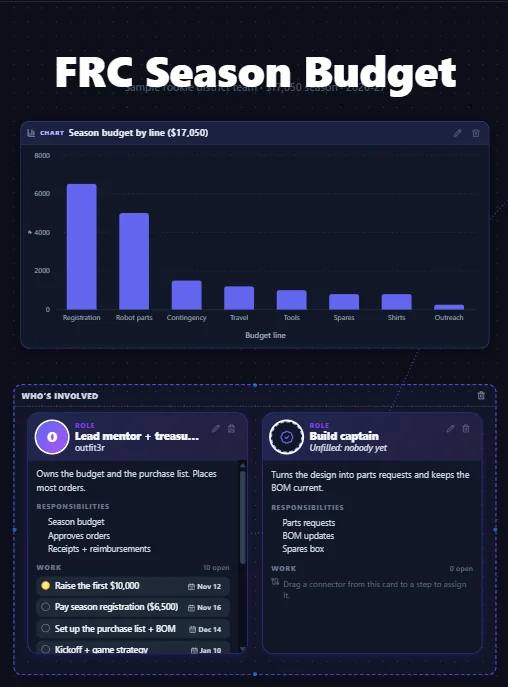
Here’s a sample budget for a made-up rookie team: 15 students, a U.S. district team, two included events within driving distance, and no machine shop. Your numbers will differ, but the shape is what matters.
| Line | Amount | Notes |
|---|---|---|
| Season registration | $6,500 | Includes Kit of Parts and two district events |
| Robot and prototyping parts | $5,000 | Rookie kit drive base, then mechanisms |
| Tools | $1,000 | Hand tools, drill, saw; they last for years |
| Spares | $800 | Motors, belts, a spare battery or two |
| Travel | $1,200 | Two day trips by bus, about $600 each |
| Shirts and team supplies | $800 | |
| Outreach | $250 | Demo materials, printing |
| Contingency (about 10%) | $1,500 | For the things nobody predicted |
| Season total | $17,050 | |
| If we qualify: District Championship | $4,000 + travel | Raised separately, only if needed |
This team lands well under FIRST’s median of about $24,000. That’s normal for a rookie with no hotel nights and no extra events. One forum mentor made the same point: a rookie season doesn’t need $20,000 to $25,000, and a team that spends $3,000 on field elements in year one is probably overspending.
Notice that the robot is under a third of the total. Registration alone is the biggest line.
Common robotics budget mistakes
These come up again and again in forum threads from mentors and students:
- Planning the robot first. It’s the fun part, so it gets planned first. But registration, travel and event fees are fixed, and they’re most of the money.
- Nobody owns the money. When several mentors buy parts on their own cards and nobody logs it, the numbers drift. One new mentor on Chief Delphi described rebuilding a messy multi-person spreadsheet from scratch for exactly this reason.
- Counting on sponsors you don’t have yet. A first-year team can’t assume corporate money will arrive. Budget from money you’ve actually secured, and treat the rest as upside.
- Trying to match the top teams. Experienced mentors warn rookies against building beyond what their tools and people can handle. Several teams on the forum say their simplest robots did better than they expected.
- Ignoring the “if we win” costs. Every spring, teams qualify for Championship and then race to raise $10,000 or more in a few weeks. Some qualify and can’t go. A plan made in the fall makes that scramble shorter.
- Spending it all. Ending at zero means next season starts with an empty account, right when registration is due.
Doing it in Flowboard
A spreadsheet works for the numbers. What it can’t show is how the money connects to the season: which orders wait on a design decision, which fees are due when and who’s handling each one. Here’s how we’d set it up in Flowboard.
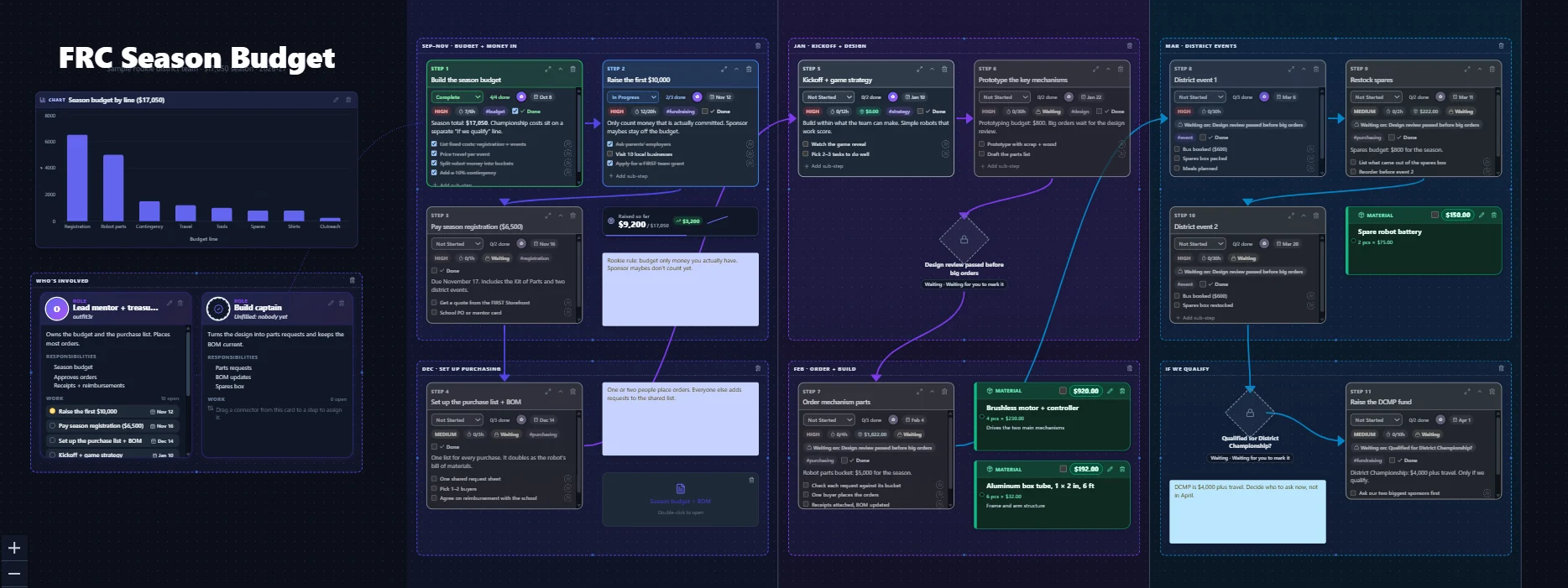
- Lay out the season on one board: registration, each event, each subsystem. Give every step an owner and track its materials and costs right on the step (visual project planning).
- Hold big orders until the design is settled with a gate, so nobody buys parts for a mechanism you later drop (gates).
- Put registration and event-fee deadlines on the timeline so they show up next to build milestones (project timelines).
- Attach your BOM sheet, quotes and receipt photos to the steps they belong to (project documents).
If you want to try it with this season’s budget, there’s a 7-day free trial.
Frequently asked questions
How much does it cost to start an FRC team?
Starting an FRC team costs at least $6,500, the 2026-27 registration fee, and most teams spend far more. FIRST’s reported median for U.S. teams is about $24,000 to $26,000 a season. A rookie team that drives to nearby events and skips extras can spend less. Registration includes the Kit of Parts and one regional or two district events.
How much does an FTC team cost?
An FTC team typically costs a few thousand dollars a season. For 2026-27, registration is $350, and FIRST estimates about $1,500 for a starter robot kit. Local event fees are set by your region’s FIRST partner, so check with them. Add travel, spare parts and team shirts to get your full season total.
What should be in a robotics team budget?
A robotics team budget should include registration, event fees, robot and prototyping parts, tools, spare parts, travel, team shirts, outreach and a contingency line of about 10%. Add a separate line for costs you’d face if you qualify for a championship. Build it before kickoff, using last season’s spending or FIRST’s median numbers as a guide.
What is a bill of materials for a robotics team?
A bill of materials for a robotics team is a list of every part on the robot, with its vendor, part number, quantity and cost. It shows what the robot actually cost and makes reordering easy. Many teams keep it in the same spreadsheet as their budget, so every purchase updates both at once.